The marshlands in midsummer offer a stunning contrast between the blue sky and the lush foliage, but they are also extremely hot and harsh environments.
Since the altitude isn't as high as during mountain climbing, the temperature isn't particularly low.
There are few trees in the wetlands, so you are exposed to direct sunlight. Furthermore, the boardwalks become hot from the sun, so hot that your meat could burn.
Therefore, contrary to its seemingly cool name, the wetland is an environment with a high risk of dehydration and heatstroke.
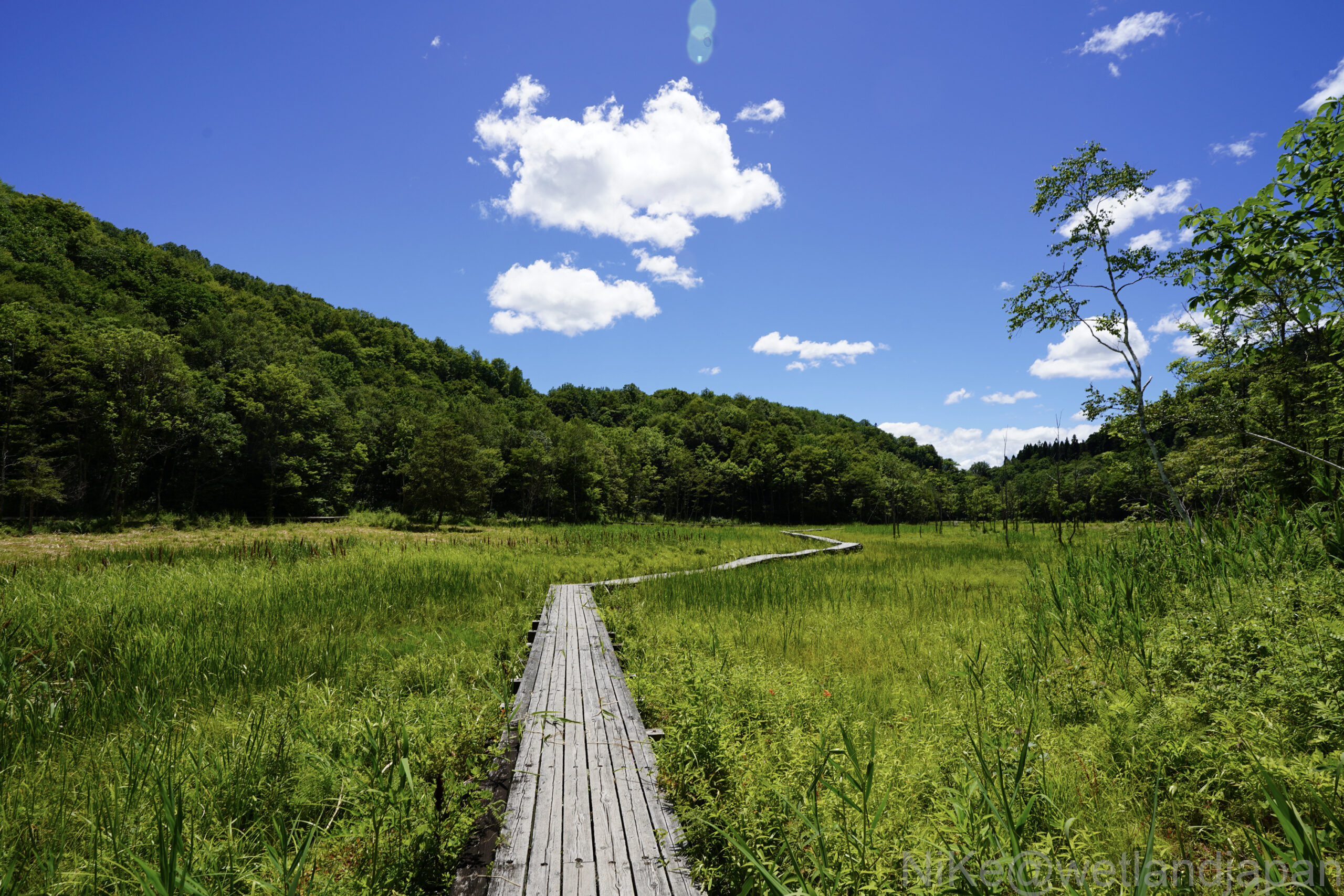
I myself often feel my life is in danger when exploring in the middle of summer.
Therefore, to help you enjoy your exploration in the height of summer, I have compiled information on the risks of dehydration and heatstroke, as well as countermeasures, which I hope will be helpful for your exploration.
About dehydration
When exploring wetlands, it is important to bring drinking water with you.
Why is that?
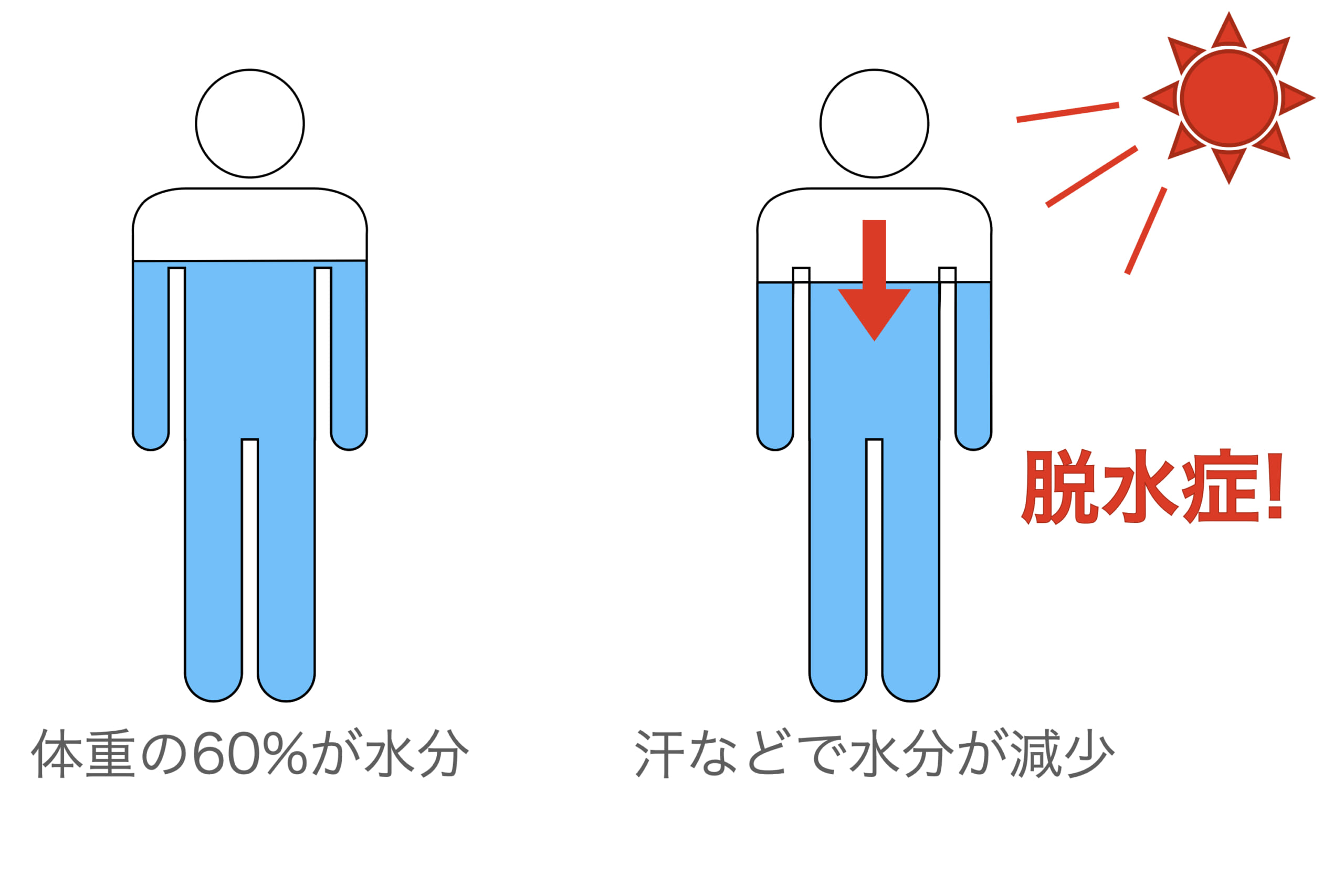
The human body contains approximately 601 TP3T of water per kilogram of body weight.
This moisture is essential for people to remain active.
Exercising in hot environments or not drinking enough fluids can lead to a decrease in body water content, a condition known as dehydration.
In healthy individuals, losing 1-2% of fluids causes thirst, and at 3%, symptoms such as severe thirst, loss of appetite, and cessation of sweating appear.
Furthermore, losing more than 5% can cause abnormalities in various bodily functions, leading to nausea, dizziness, and mental disturbances.
Furthermore, they will die if they lose 10-20% of water.
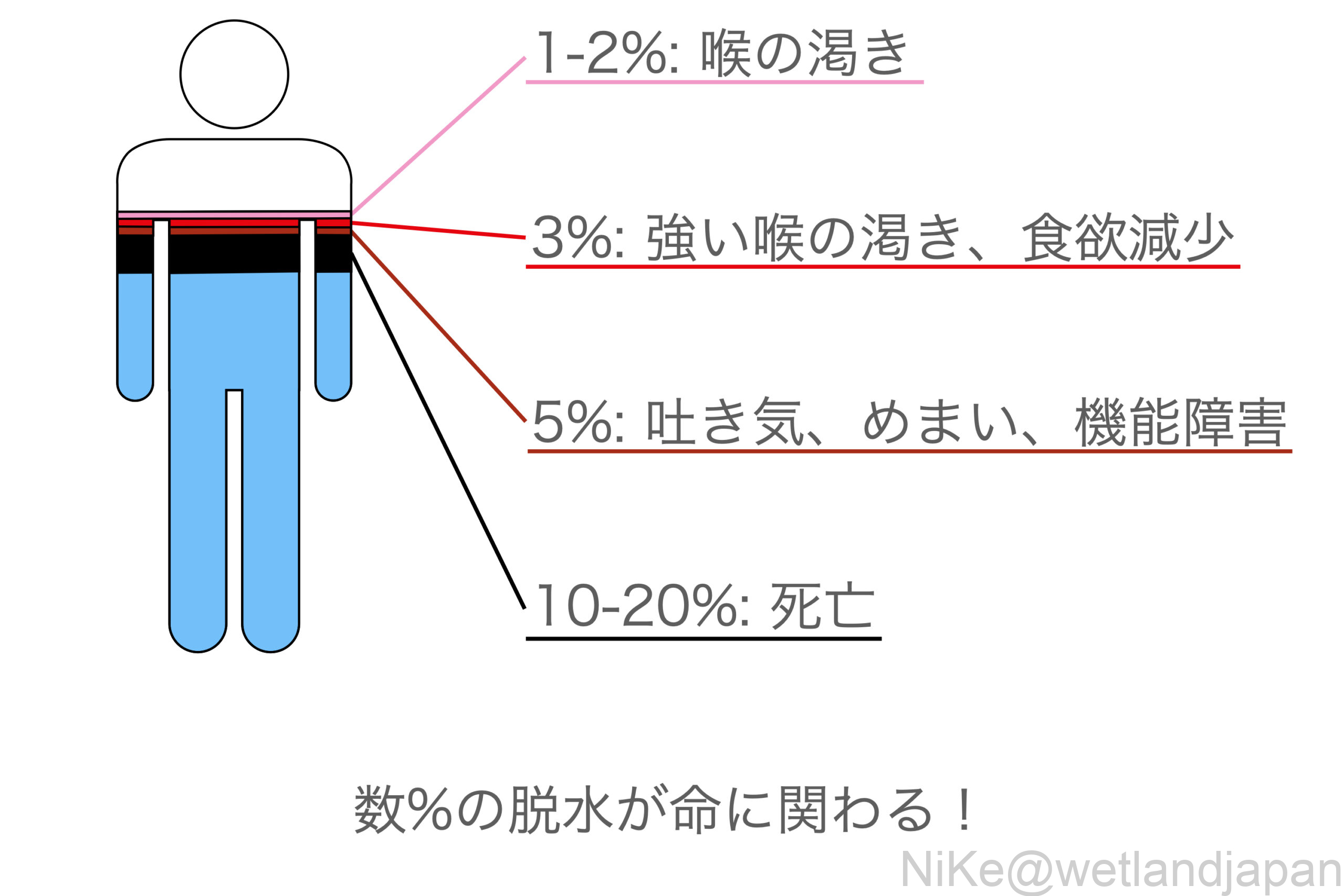
Since 5% can cause abnormalities in mental and physical function, it will likely be difficult to resolve the symptoms on your own once they have progressed to this stage.
Assuming a person weighs 60 kg, losing approximately 3.5 to 4 liters of fluid would be fatal.
Furthermore, dehydration increases the risk of heatstroke.
First, let's look at the indicators of dehydration as follows.
What is the early indicator of dehydration in a person weighing 60 kg?
Let's calculate how much 1-2% corresponds to, which is the first line where you start to feel thirsty.
The amount of water in the body is approximately 601 TP3 T for an adult's body weight, so for a 60 kg person, that would be 36-39 L.
A loss of 1-21 TP3T (360-780 ml) of fluid is the point at which you start to feel thirsty.
360-780 ml is roughly equivalent to one plastic bottle.
Indeed, losing this much moisture feels dangerous.
So, what measures should be taken?
Basic measures to prevent dehydration
The solution is very simple: it's important to make sure you're getting enough fluids and salt.
Apparently, by the time you feel thirsty, you've already lost 1-2% of fluids.
If you realize you've drank water, it's crucial to drink as soon as possible to prevent dehydration.
Even if you drink 500 ml of water all at once when you're thirsty, not all of it will be absorbed.
Therefore, when engaging in outdoor activities such as exploring wetlands, it's a good idea to make a point of drinking regularly before you feel thirsty.
Furthermore, sweat contains not only water but also salt.
Therefore, if you only drink water, you may become more prone to leg cramps and spasms due to a lack of salt.
It's best to consume salt along with water.
Because I sweat easily, I take 1-2 liters of water with me when strolling through wetlands, and about 4-5 liters (including lunch) when hiking in the mountains on a day trip.
Drinks are heavy in luggage, so you might be tempted to pack less, but I make sure to bring enough so that I won't run out even if I drink a lot.
If you have leftover water after hiking or exploring, just think of it as good training.
I transport water in a large-capacity container like a Platypus, and then transfer it to smaller bottles called Nalgene bottles.
This reduces the risk of polluting or losing the source water.
Platypus 2L
It's convenient because it can be gradually reduced in size each time you use water.
Since washing it is a hassle, I use it without putting it directly to my mouth.
When I get home, I lightly wash the inside, empty it, fold it up, and freeze it in the freezer.

 Pochip
Nalgene bottle 500 ml
A well-known and famous bottle.
It has a simple design, is easy to wash, and is durable.
It's fine to freeze it or put boiling water in it.
This is a book that can be used from start to finish.
 Pochip
In addition, sports drinks such as Aquarius are useful in stores where you can get fluids, salt, and sugar all at once.
Personally, I find regular Aquarius too sweet, so I dilute it with water at a 1:1 ratio.
Additionally, you can replenish your salt intake by bringing salty snacks such as plum candy, salt candy, or beef jerky.
These are especially delicious when eaten in the scorching sun, so I highly recommend them.
Beef jerky
I didn't particularly like it, but it's a treat when eaten in the scorching sun.
Since it provides both salt and protein at the same time, there's probably nothing better than this.
The downside is that it's expensive.
 Pochip
Pickled squid
It's a delicious combination of protein and sourness.
A taste that soothes the fatigue of exploration and the heat.
I don't like how sticky my hands get, so I leave it in the car and eat it when I get back.
 Pochip
Plum kelp
I recommend all the plum-based foods.
It's low in calories, but the saltiness is unbearable.
This is something you should definitely bring along for summer activities.
 Pochip
About heatstroke
Heatstroke is also a major enemy of outdoor activities in the middle of summer.
Heatstroke refers to a condition in which the body's temperature regulation system fails to function properly, causing heat to build up inside the body.
It can be caused by prolonged activity in hot and humid environments, or by an imbalance in the body's water and salt levels.
Heatstroke can begin with lightheadedness or dizziness, progress to vomiting and convulsions, and eventually lead to impaired consciousness.
If you experience muscle discomfort, lightheadedness, or dizziness, it's a good idea to consider it a dangerous sign.
Heatstroke prevention measures
To summarize, it's important to stay well-hydrated and limit your activity level in the scorching sun while maintaining good health.
As a premise, people in good health are less likely to suffer from heatstroke.
Eating three proper meals a day and getting enough sleep are the first and most basic ways to prevent heatstroke.
However, when going on expeditions such as mountain climbing or exploring wetlands, I often leave late at night to avoid traffic jams, or I cram in work so that I can take paid leave.
While it's understandable for working adults who enjoy outdoor activities, it's crucial to recognize that you belong to a risk group and act accordingly.
Next, I'll write about equipment.
Protect your head from direct sunlight by wearing a hat and draping a towel around your neck.
Wear breathable clothing, especially clothes made of materials that dry quickly. Sweat helps lower your body temperature through evaporative cooling, which can make you feel a little better.
Bringing water and a wet towel would be a good idea.
Taking frequent breaks is also important.
Continuing to be active in the scorching sun is quite dangerous in itself.
Furthermore, sweating in the heat and becoming dehydrated increases the risk of heatstroke.
It is essential to take frequent breaks in the shade and to be mindful of staying hydrated and consuming salt.
When someone suffers from heatstroke, it's necessary to immediately cool down the major blood vessels.
It would be wise to have some cooling packs on hand.
Instant cooling agent
By hitting it, the temperature drops instantly.
Since it can be carried around at room temperature, it would be a good idea to keep it on hand for first aid.
Luckily, I haven't had to use it.
I also think it's a good idea to use it preventively.
 Pochip
In addition to the above, it is convenient to freeze drinks in advance at your accommodation.
You can also buy frozen drinks at convenience stores.
summary
Ideally, I'd like to focus on mornings and evenings, and rest in a cool place during the hottest part of the day, but I don't want to reduce my activity time since I've traveled all this way.
To be honest, I want to carry out my activities while minimizing risks as much as possible.
That being said, life is the most important thing, so it's crucial to acquire the knowledge necessary to be able to immediately take action if you notice any changes in your physical condition.
By being mindful of dehydration and heatstroke during activities, the risk of heatstroke can be reduced.
Stay cool and enjoy your time in the wetlands!
 ENGLISH
 JAPANESE
Comments